
Description
PrymaLab · Research Use Only
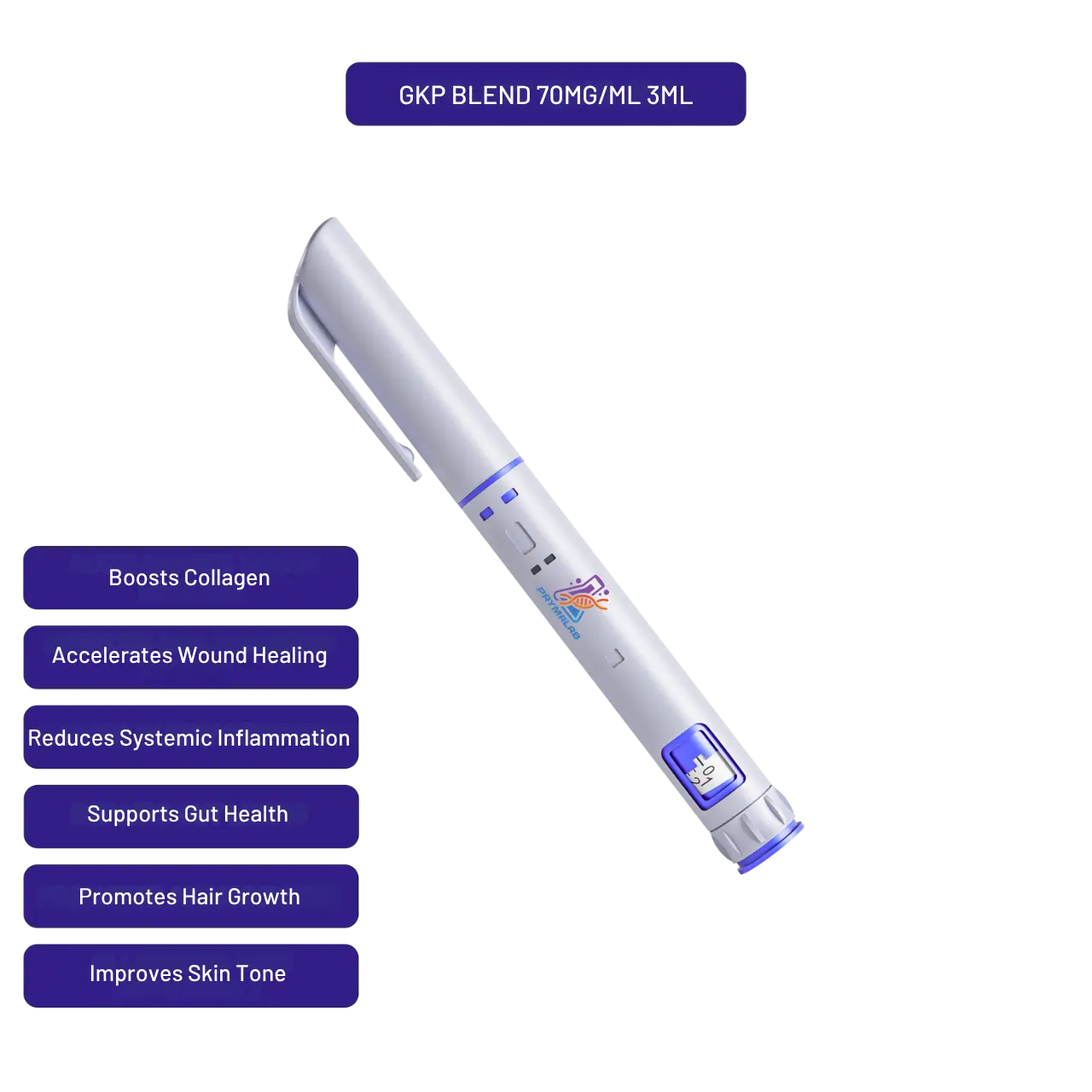
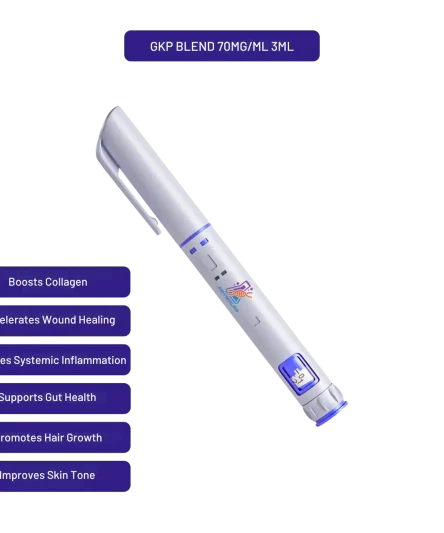
Preloaded Autoinjector | GKP BLEND | 3ml Pen | 70mg/ml
GHK-Cu + BPC-157 + KPV in solution · 3ml at 70mg/ml
The GKP blend autoinjector is a preloaded 3ml research device holding GHK-Cu, BPC-157 and KPV in solution at 70mg/ml. Total peptide comes to 210mg. The vial equivalent is supplied at a documented 50/10/10 split, which makes this one of the few blend devices where the composition can be inferred with some confidence.
Specification Table
| Property | Value |
|---|---|
| Device format | Preloaded autoinjector pen, glass cartridge |
| Fill volume | 3 ml |
| Concentration | 70 mg/ml total peptide |
| Total peptide in device | 210 mg |
| Components | GHK-Cu, BPC-157, KPV |
| Vial equivalent composition | GHK-Cu 50mg, BPC-157 10mg, KPV 10mg per 70mg |
| Device composition | Not stated on the product record. If scaled from the vial ratio, approximately 150mg, 30mg and 30mg |
| CAS, GHK-Cu | 89030-95-5 |
| CAS, BPC-157 | 137525-51-0 |
| CAS, KPV | 67727-97-3 |
| MW, GHK-Cu | 401.91 g/mol |
| MW, BPC-157 | 1419.55 g/mol |
| MW, KPV | 342.43 g/mol |
| Target, GHK-Cu | Copper(II) coordination, fibroblast collagen synthesis |
| Target, BPC-157 | VEGFR2 with downstream Akt and eNOS activation |
| Target, KPV | NF-κB signalling via PepT1 uptake |
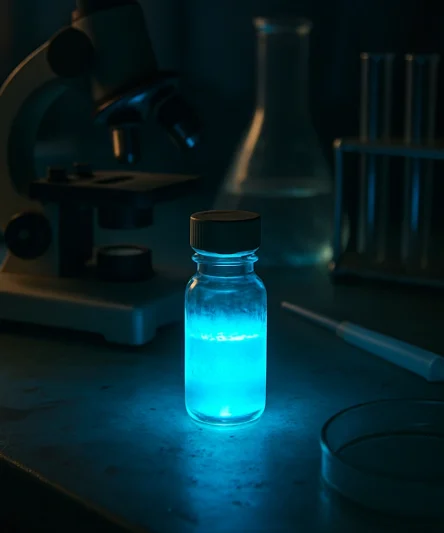
| Solution appearance | Clear blue to blue-violet |
| Reconstitution required | None |
| Excipient system | Not published on the product record |
| Solution stability | Not established over device shelf life |
| Storage | 2-8°C, protected from light |
| Purity | Per lot-specific certificate of analysis |
| Regulatory status | No approved human or veterinary formulation for any component |
Can the Device Composition Be Inferred?
Partially, and the GKP blend autoinjector is unusual in that respect, because the vial equivalent publishes its split while most blends do not.
The GKP vial is documented at 50mg GHK-Cu, 10mg BPC-157 and 10mg KPV, totalling 70mg. If the device at 70mg/ml scales that ratio proportionally across 3ml, the contents would be approximately 150mg GHK-Cu, 30mg BPC-157 and 30mg KPV.
The word if is doing real work in that sentence. Nothing on the product record states that the device uses the same ratio, and manufacturers sometimes reformulate for solution stability rather than replicating a lyophilized composition exactly. A copper-containing solution in particular might justify a different balance.
Treat the inferred figures as a hypothesis awaiting confirmation, not as specification. Where a study depends on knowing the actual composition, an inference of this kind is simply not good enough to build on.
What Does the Molar Picture Look Like?
Assuming the vial ratio holds across formats, the molar disparity between components turns out to be substantial.
At 401.91 daltons, 150mg of GHK-Cu works out at roughly 373 micromoles of material. Thirty milligrams of BPC-157 at 1419.55 is approximately 21 micromoles. Thirty milligrams of KPV at 342.43 is approximately 88 micromoles.
GHK-Cu therefore outnumbers BPC-157 by roughly eighteen to one on a molar basis, and KPV by roughly four to one. The copper tripeptide dominates numerically as thoroughly as it does by mass.
Those are the numbers to normalise against when comparing with single-component preparations. Not the 70mg/ml label. Every one of those figures stays provisional until the composition is confirmed.
Why Does Solution State Matter for This Combination?
The copper component is the reason, and the mechanism is specific rather than general.
Copper(II) absorbs visible light, which is why the solution is blue. Absorbed energy can drive photoreduction to copper(I), and copper(I) with dissolved oxygen participates in Fenton-type chemistry producing hydroxyl radicals. Those radicals attack indiscriminately.
Composition determines who is exposed. Neither BPC-157 nor KPV contains cysteine, methionine, tryptophan, tyrosine or histidine, the five residues most susceptible to that chemistry. BPC-157 runs Gly-Glu-Pro-Pro-Pro-Gly-Lys-Pro-Ala-Asp-Asp-Ala-Gly-Leu-Val. KPV is three residues, Lys-Pro-Val.
On sequence grounds this is a comparatively favourable combination to hold in a copper-containing solution, considerably more so than the GLOW and KLOW blends which both include thymosin β4 and its methionine. That is an inference from composition rather than a stability measurement, and it does not substitute for one.
How Should the GKP Blend Autoinjector Be Verified?
For the GKP blend autoinjector, colour is the first and cheapest check. Clear blue to blue-violet is expected. Fading toward colourless indicates the GHK-Cu component has lost copper, and a shift toward green or brown indicates uncharacterised chemistry.
Inspect against dark and light backgrounds alike. Aggregation shows as faint opalescence long before obvious turbidity, and only a dark background reveals that early stage.
Gravimetric verification establishes actual delivered volume. Actuate onto a tared vessel, record mass, convert by solution density, repeat across several actuations for accuracy and precision. Perform it at the temperature of intended use, because cold solution is more viscous and viscosity changes delivery in a spring mechanism.
Throw away that first actuation instead of recording it as data. Air entering the delivery path, and seals relaxing during storage, both under-deliver on that first actuation.
How Does the Device Compare With the Vial?
The GKP pairing is unusual in this catalogue because both formats exist and the vial publishes its composition, which makes the comparison unusually concrete.
The vial arrives lyophilized, split 50/10/10 across 70mg, and documented as such on the product record. Reconstituting it introduces the familiar variability: diluent measurement, incomplete dissolution, shear, adsorptive loss during transfer. Three components dissolving together makes incomplete dissolution a real risk, since one under-dissolved component shifts the composition invisibly.
The device removes all of that and fixes concentration at manufacture, at the cost of solution-state storage from that point onward.
For this particular combination the solution-state cost is lower than for GLOW or KLOW. Neither BPC-157 nor KPV contains any of the residues most vulnerable to copper-catalysed oxidation, so the copper component has less to attack than it would alongside thymosin β4 and its methionine.
The deciding factor is usually study duration. A short intensive programme favours the device. Work spread across many months favours reconstituting vials as needed, since accumulated time in solution is the variable that grows.
Which Questions Does This Device Leave Open?
Three of them. Naming them openly is more useful than implying the record is complete.
Whether the device actually replicates that vial ratio remains unconfirmed. The inference is reasonable. If it is wrong, every molar calculation shifts.
The excipient system is unpublished. Whatever it contains travels into any downstream assay the drawn solution joins. For a copper-containing formulation, the presence of an antioxidant or chelator is no trivial detail.
Shelf-life stability is unpublished, leaving device lifetime to be set by policy rather than data.
None of these gaps is unusual for research-format material of this kind. All three are reasonable to request and unreasonable to assume, and a laboratory depending on any of them should ask before rather than after.
Handling the Device in Laboratory Practice
Hold the device at 2-8°C away from light. Return it to its packaging between sessions. Light exclusion here addresses one specific photochemical route through copper, not a general precaution.
Let the device equilibrate to ambient temperature before actuating, and inspect it before every single draw.
Where the drawn solution enters a buffered downstream system, check that buffer for chelating agents. EDTA will strip copper from the GHK-Cu component regardless of how carefully the device itself was handled, and the findinging failure presents as an inactive compound rather than as a buffer problem.
Record device lot, date of first actuation, storage conditions and volume drawn each session. With shelf-life stability unpublished, the interval between first use and each later draw is a variable that belongs in the data record.
Recording Device Use
Because shelf-life data is unpublished, the record substitutes for it, and that makes documentation more consequential here than for a lyophilized vial.
Write the date of first actuation on the device itself. Marker on the barrel does the job, and it settles any later question about service life.
Log the lot number, storage conditions and volume drawn each session, together with a note on how the solution looked at the time.
Where a device spans more than one experimental series, note which series drew from which device. A finding that later looks anomalous can then be checked against device age rather than being unexplainable.
What Are the Three Components Reported to Do?
A peptide blend is only interpretable component by component, since nothing has been published on the combination.
GKP is GHK-Cu, KPV and BPC-157, and the name is the first letter of each.
GHK-Cu is the copper peptide, carrying the largest cosmetic record of the three. Reported effects cover collagen production, elastin and tissue remodeling, drawn mostly from topical studies and cell culture.
KPV is the C-terminal tripeptide of alpha-melanocyte-stimulating hormone, and its reported activity is anti-inflammatory. It interferes with NF-kB signalling inside the cell rather than blocking a receptor, and its best work is in colitis models.
BPC-157, body protection compound 157, is a gastric protein fragment reported to drive angiogenesis and cell migration, with tissue healing in rodent tendon and ligament injury models.
Wound healing appears in the reported record for all three, and connective tissue repair is the outcome the combination is sold on. Tissue repair of that kind is reported per component and never for the assembly.
A glow stack differs only in swapping KPV for TB-500, so a glow stack and this blend answer to the same absence of combination data.
The three do at least divide the labour coherently on paper: one for matrix, one for inflammatory markers, one for vascular supply.
Coherent on paper is not the same as tested, and nothing published examines whether that division holds when the three are given together.
What Is Not Established About the GKP Blend?
The gaps are the same shape as for any research peptide blend, and worth stating rather than implying.
No study has tested this combination. There is no published work on interaction between the components, on additivity, or on whether one interferes with another.
A KLOW blend is the four-component relative, adding TB-500 to a similar base. A glow blend is the three-component version built on GHK-Cu, BPC-157 and TB-500 instead, so a glow blend swaps this one’s KPV for TB-500 and a glow stack is that same swap under a second name.
All three are marketing assemblies rather than developed formulations, and the differences between them were decided by vendors rather than by data.
A KLOW protocol or a comparable dosing schedule circulating for this blend is vendor guidance, not a tested regimen. The same applies to a glow stack schedule, since a glow blend and a glow stack are the same assembly under two names.
Peptide therapy clinics list a glow blend, a GKP blend and a KLOW blend beside each other with no stated reason to prefer one, and often beside MOTS-C and other metabolic peptides that share nothing with any of them.
Bioavailability by subcutaneous injection has not been published for any of these assemblies, so a comparison between them on bioavailability grounds has nothing to rest on.
Some peptide therapy providers order a CBC before a course. A complete blood count is sensible clinical practice and it is not evidence the course does anything.
Fibrosis is worth one line in the other direction. A compound promoting matrix deposition is promoting it without discrimination, and no study has looked at what repeated exposure does over time.
Skin and hair health is the broadest claim attached to these blends, and an insulin syringe drawing from a vial does not make it better evidenced than a device does.
Claims about skin rejuvenation, skin repair, skin health, skin elasticity, skin regeneration and accelerate healing come from the GHK-Cu literature. Reduce inflammation claims come from KPV, and gut health claims from BPC-157.
Reported anti-inflammatory effects and changes in inflammatory markers such as CRP have not been measured for this blend in anyone.
Antioxidant defense and cellular repair are the broadest phrases in the marketing and correspond to no measured endpoint at all.
None of the three is FDA-approved. BPC-157 has been placed among substances presenting significant risks for compounding, so compounding pharmacies in the United States cannot lawfully supply it, and KPV did not secure a place on the 503A bulks list either.
Copper accumulation deserves separate mention. GHK-Cu delivers copper, and a repeated injectable copper load is a different exposure question from topical use, uncharacterised for this blend.
This device is supplied for laboratory research only and is not for administration to humans or animals.
What Should the Certificate Show for a Three-Peptide Blend?
A blend raises certificate questions a single compound does not, and these are the ones most often left open.
Individual concentration for each component, stated separately, is the figure that matters. A single total tells you nothing about the split.
HPLC should resolve three peaks with an area for each, and mass spectrometry confirms identity where retention alone cannot.
The three differ enough in mass that any competent instrument separates them, so there is no analytical excuse for leaving this unanswered.
Solution-state stability is the other question. Deamidation and hydrolysis both proceed in water, and a three-component solution ages on three clocks rather than one.
Half-life figures quoted for individual components describe circulation after administration, not shelf life in a device, and the two get conflated constantly.
Bacteriostatic water and reconstitution belong to the vial presentation. Where a buyer reconstitutes a lyophilized powder blend with bac water, the split cannot be apportioned by weighing at all.
Sterility and endotoxin testing matter for any injectable format, and a purity percentage covers neither.
Questions about a U-100 insulin syringe, injection technique, or whether to use the abdomen or the thigh belong to clinical guidance for approved medicines. None of it applies to a research chemical that is not for administration to anyone.
Injection site reactions are what gets reported anecdotally for subcutaneous injection of unbuffered peptide solutions, and they reflect the formulation as much as the compounds.
Published Literature
Cross-checked against publisher records or primary indexes. Each covers one component, and none covers the combination or this particular delivery format.
- Maquart FX, Pickart L, Laurent M, Gillery P, Monboisse JC, Borel JP. FEBS Letters. 1988;238(2):343-346.
- Pickart L, Margolina A. International Journal of Molecular Sciences. 2018;19(7):1987. PMID: 29986520
- Hsieh MJ, Liu HT, Wang CN, et al. Journal of Molecular Medicine. 2017;95(3):323-333.
- Dalmasso G, Charrier-Hisamuddin L, Nguyen HT, Yan Y, Sitaraman S, Merlin D. Gastroenterology. 2008;134(1):166-178.
- Kannengiesser K, Maaser C, Heidemann J, et al. Inflammatory Bowel Diseases. 2008;14(3):324-331.
- Sikiric P, Seiwerth S, Rucman R, et al. Current Pharmaceutical Design. 2011;17(16):1612-1632. PMID: 21548867
Frequently Asked Questions
What is the GKP blend autoinjector?
A preloaded 3ml research device containing GHK-Cu, BPC-157 and KPV in solution at 70mg/ml, giving 210mg total. No reconstitution is required. Supplied for laboratory research use only and not approved for human or veterinary use in any jurisdiction.
What is in the device?
The same three compounds as the GKP vial. The vial publishes a 50mg, 10mg and 10mg split across 70mg total. If the device scales that ratio proportionally, contents would be roughly 150mg GHK-Cu, 30mg BPC-157 and 30mg KPV, though nothing on the record confirms this.
Can the composition really be inferred?
Only provisionally, and the distinction matters more than it might appear. Manufacturers sometimes reformulate for solution stability rather than replicating a lyophilized composition exactly, and a copper-containing solution could easily justify a different balance. Treat the inferred figures as a hypothesis requiring confirmation.
What does the molar composition look like?
Assuming the vial ratio carries across, roughly 373 micromoles of GHK-Cu against 21 of BPC-157 and 88 of KPV. GHK-Cu outnumbers BPC-157 by around eighteen to one. It dominates the preparation numerically as thoroughly as it does by mass.
Why does copper matter in solution?
Copper(II) absorbs visible light, and absorbed energy can drive photoreduction to copper(I), which with dissolved oxygen participates in Fenton-type chemistry producing hydroxyl radicals. Those radicals attack indiscriminately. Light exclusion here is therefore specific rather than generic.
Is this a favourable combination to hold in solution?
On composition grounds, comparatively yes. Neither BPC-157 nor KPV contains a single one of the five residues most susceptible to copper-catalysed oxidation. GLOW and KLOW both carry thymosin beta 4 and its methionine, which changes the picture considerably.
How should the device be verified?
Begin with colour. Clear blue to blue-violet is expected, and fading points to copper loss from the tripeptide. Inspect against a dark background as well, since aggregation appears as faint opalescence before turbidity. Then confirm delivered volume gravimetrically across several actuations.
Why discard the first actuation?
Air ingress into the delivery path and seal relaxation both cause under-delivery on the first actuation after a rest period. Unless a priming step is specified and followed, that first draw should be discarded rather than measured, since it will not represent the device performance.
Does buffer choice still matter with a device?
Yes, downstream. EDTA and other chelators in any buffer the solution enters will strip copper from the GHK-Cu component regardless of how carefully the device was handled. The failure presents as an inactive compound rather than a buffer problem. That makes it easy to misdiagnose.
How does this compare with the GKP vial?
Same three compounds in a different physical state, and the trade-off runs both ways. The vial ships lyophilized, suppressing degradation, but requires reconstitution and the variability that introduces. The device removes reconstitution entirely and accepts solution-state storage from manufacture onward instead.
How does the device compare with the GKP vial?
The vial arrives lyophilized at a documented 50/10/10 split and requires reconstitution, which introduces measurement error, incomplete dissolution, shear and adsorptive loss. The device removes all of that and fixes concentration at manufacture, accepting solution-state storage in exchange.
Is solution storage riskier for this blend than for GLOW?
Less so. Neither BPC-157 nor KPV contains any of the residues most vulnerable to copper-catalysed oxidation, so the copper component has less to attack here than it would alongside thymosin beta 4 and its methionine, which both GLOW and KLOW contain.
Which format should a long study use?
Vials, generally. Accumulated time in solution is the variable that grows with study duration, so work spread across many months favours reconstituting as needed. Short intensive programmes favour the device and its between-session consistency.
What should be written on the device itself?
The date of first actuation, in marker on the barrel, which costs nothing and settles any later question about service life. Shelf-life data for this formulation is unpublished. That absence makes the written date the only reliable record of how long a device has been open.
How should device use be logged?
Lot number, storage conditions, volume drawn each session, and the appearance of the solution on that occasion. Where a device spans more than one experimental series, note which series drew from which device so an anomaly can be checked against device age.
What is in the GKP blend?
GHK-Cu, KPV and BPC-157, one letter each. The KLOW blend is the four-component relative adding TB-500, and a glow blend is the three-component version using TB-500 in place of KPV. All are marketing assemblies rather than developed formulations.
Has the combination been tested?
No. Each peptide has its own preclinical record and none of those records involved the other two. A KLOW protocol, a glow stack schedule or any comparable dosing schedule for this blend is vendor guidance rather than a tested regimen.
What does each component contribute on paper?
GHK-Cu for matrix, through collagen and elastin. KPV for inflammatory markers, through NF-kB signalling. BPC-157 for vascular supply, through angiogenesis. That division of labour is coherent on paper and untested in combination.
Does it need reconstitution?
Not in this format, which arrives in solution. A lyophilized powder blend needs bacteriostatic water, and where a buyer adds bac water the resulting split between three peptides cannot be apportioned by weighing at all.
What should the certificate show?
Individual concentration for each of the three stated separately, an HPLC trace resolving three peaks, and mass confirmation for each. Ask for sterility and endotoxin testing. Bioavailability by any route has not been published for this blend.
Are these compounds approved?
None is FDA-approved. BPC-157 sits among substances the FDA flagged as presenting significant risks for compounding, and KPV did not secure a place on the 503A bulks list, so compounded medications containing either are no longer lawfully available in the United States.
How does it compare with conventional options?
In dermatology and in inflammation generally, the established options have trial data behind them. NSAIDs have decades of it for inflammation. An untested peptide blend has none, and peptide therapy providers grouping them together are grouping by market.
What is known about half-life and mechanism detail?
Half-life figures quoted per component describe circulation after administration, not shelf life in a device. Mechanistic detail varies: actin polymerization for TB-500 in the related blends, lysine-containing sequence chemistry for KPV, and gene expression work for GHK-Cu.
Compliance Statement
The GKP blend autoinjector is sold exclusively for laboratory research use. It is not a drug, food, or cosmetic product, and it is not a dietary product of any kind. It is not approved by the FDA or any comparable authority for human or veterinary use. This product is not intended to diagnose, treat, cure, or prevent any disease. It must not be given to humans or animals. Purchase is restricted to qualified researchers and institutions operating within applicable laws. All handling is the responsibility of the purchasing laboratory.








15 reviews for Preloaded Autoinjector | GKP BLEND | 3ml Pen | 70mg/ml